Warm light, in slices.

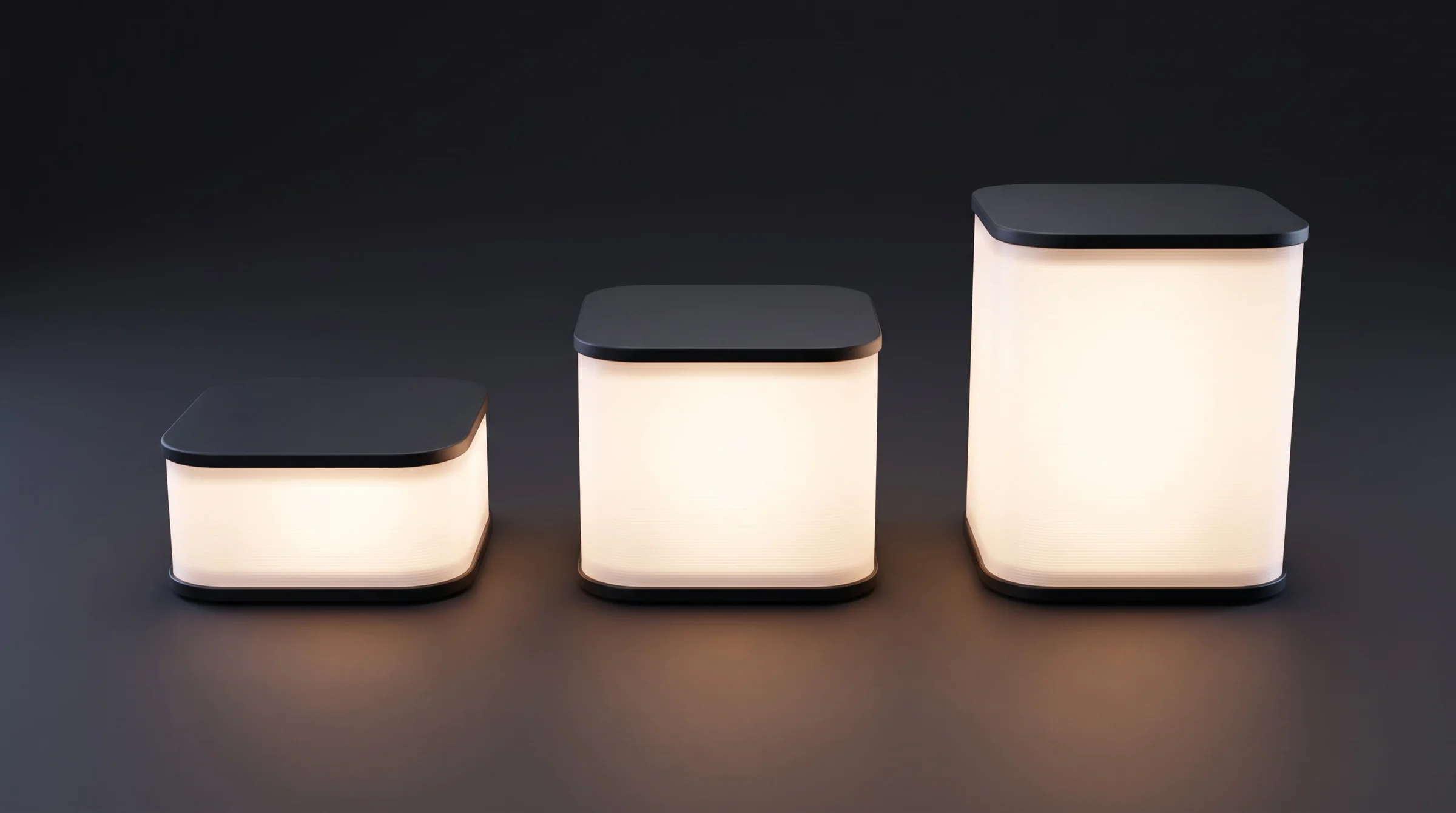
The light slice is a ring of LEDs hidden behind a matte diffuser, held between two thin black frames. It comes in three heights, 48, 80 and 112 millimeters, and you can put one or more on the same base.

Back to how it works

Three light slices side by side on a dark surface, from the short one to the tall one, each lit in warm white, with the black frame at the bottom and the black cover on top.
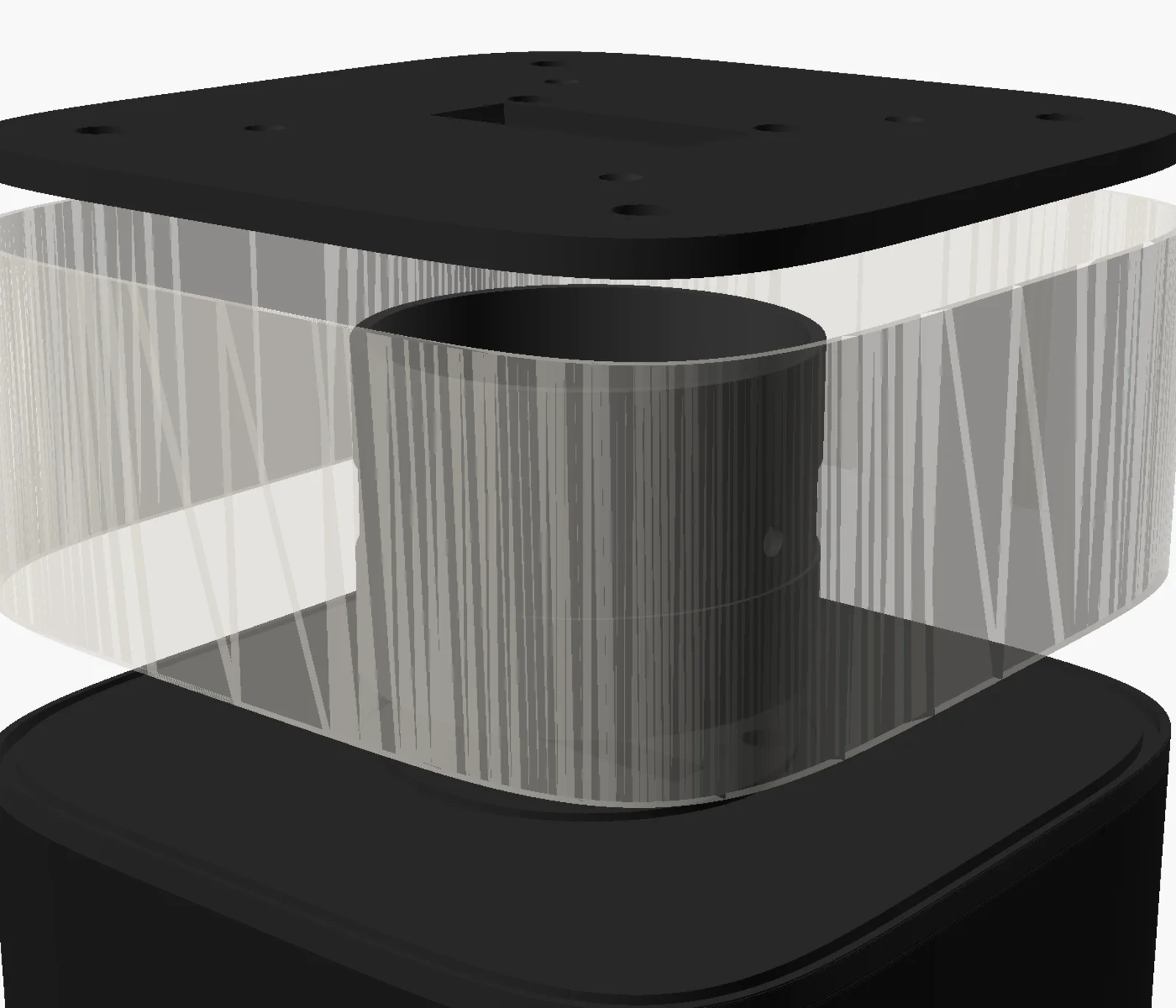
Exploded drawing of the slice: the black cover on top, the translucent diffuser with print lines, the cylindrical core in the middle and the black frame at the bottom.
The slice taken apart, from the 3D model: cover, diffuser, core and frame.

A ring of light, not a bulb.

In the middle of the slice is a 60 millimeter cylindrical core, and on it, a ring of SK6812 RGBW LEDs with warm white. The LEDs don’t face you, they face the diffuser all around them, a few centimeters away. The light mixes along the way and reaches the matte wall as one continuous surface, with no dots and no stripes.

The diffuser is set back a millimeter and a half from the frame, so you can read the black line between slices and so the edge stays protected. The frame is matte black PLA, with rounded edges, 0.8 millimeters at the bottom and 0.6 at the top. The slice’s cover is fixed to the core and the diffuser, so the magnets of the module above lift the whole slice, not just the cover.

On the back, engraved 0.3 millimeters deep into the black frame, is the name STRAT. You only see it if you turn the lamp around.
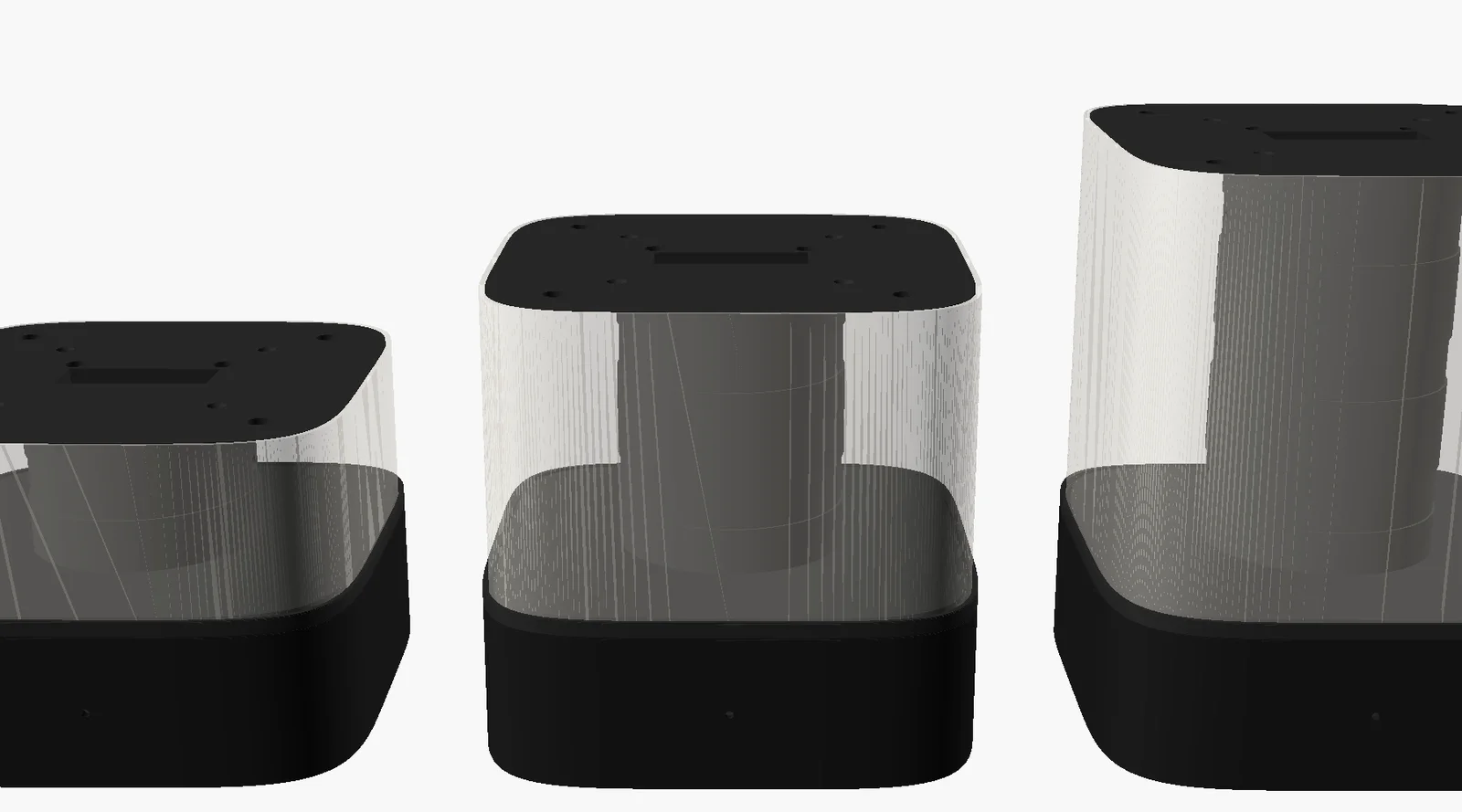
Three slices on three bases, in a technical drawing: S at 48, M at 80 and L at 112 millimeters, all the same width.
S, M and L on the same base, from the 3D model. The width doesn’t change, only the diffuser grows.

Three heights, the same frame.

L48 has a single band with 11 LEDs and is the nightstand slice: enough light to read by, short enough not to shine in your eyes. L80 has two bands and 22 LEDs, for a desk or hallway lamp. L112 has three bands and 33 LEDs and fills a room.

The frame and the cover are the same on all three; only the core and the diffuser change. The bands are evenly spaced over the height of the diffuser, roughly as far apart as the distance to the wall, so the light is just as even whatever the height. They’re wired in series, DIN to DOUT, through the holes in the core, and the base sees them as a single chain.

At 5 volts, the S slice draws around 0.7 amps, M around 1.4 and L around 2. The prototype’s 4 pin connector is at its limit with L; with the 8 pin, 5 amp one, there’s plenty of margin.

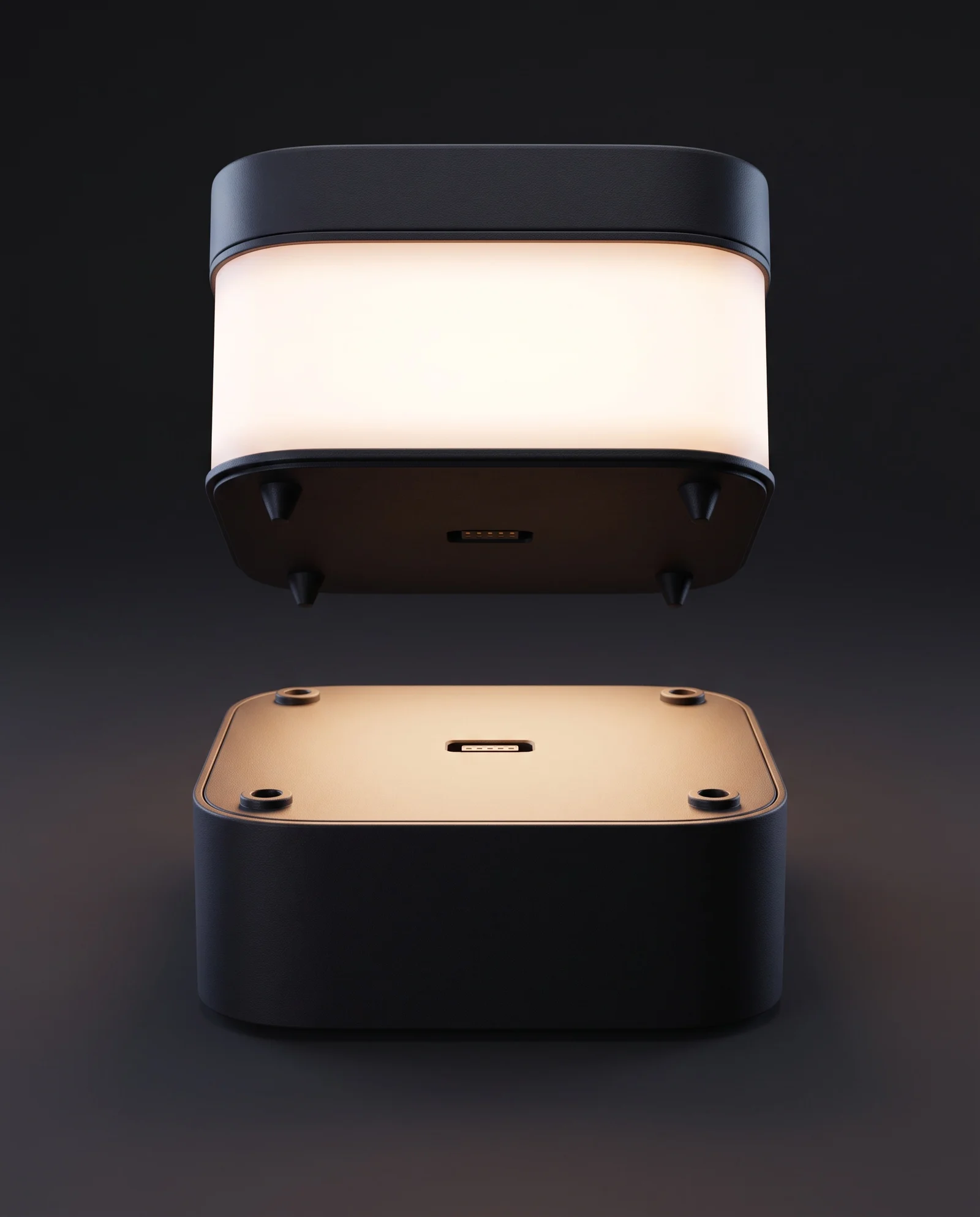
A slice lifted a few centimeters above the black base, with the four conical centering pins visible under the frame and the edge of the diffuser glowing warmly.
Under the frame, four conical pins go into the sockets in the base, and the slice settles into place on its own.

A diffuser made of a single line.

The diffuser is printed in natural translucent PETG, with no color, in vase mode: a single continuous spiral, from bottom to top, with no seams and no retractions. The 0.6 millimeter nozzle lays down a line 1.2 millimeters thick, in 0.3 layers. The wall is thin enough to let the light through and thick enough that you can’t see through it.

We chose this approach because a wall made of a single line has no internal joins that would show up as shadows when light passes through it. The fine ridges of the spiral scatter the light once more, like frosted glass.

The frame and the cover are printed in matte black PLA, in 0.2 millimeter layers, so the rounded edges come out clean. No part of the slice needs supports.

From nightlight to sunrise.

The lamp has a few states, not a color wheel. Nightlight is the dimmest light, for the night when you get out of bed and don’t want to wake anyone. Relax is warm and low, for the evening. Focus is whiter and brighter, for the desk where you work.

Sunset dims the light slowly, over tens of minutes, from warm white toward orange, until it goes out. Sunrise does the reverse, in the morning, before the alarm. Presence is the response to the sensor module: when someone walks past the lamp at night, the slice lights up dimly, toward the floor, and turns off on its own.

All the states can be changed from the lamp’s web page, on your network, with no account and no cloud. The warm white channel of the RGBW LEDs means that everyday light is truly white, not a mix of red, green and blue.

Specifications.

Internal code L48 · L80 · L112. The dimensions are those of the v0 prototype and may change.

Heights
48, 80 and 112 mm (S, M, L)
Footprint
127 × 127 mm, superellipse corners
LEDs
11 / 22 / 33, in 1 / 2 / 3 bands
LED type
SK6812 RGBW, warm white
Current at 5 V
approx. 0.7 / 1.4 / 2 A
Core
Ø 60 mm, LEDs chained DIN → DOUT
Diffuser
natural translucent PETG, vase mode, 0.6 nozzle, 1.2 mm line, 0.3 mm layers
Diffuser setback
1.5 mm from the frame
Frame and cover
matte black PLA, rounded edges 0.8 mm at the bottom, 0.6 mm at the top
Joint between modules
the same 0.8 mm radius on both edges, a fine, even line
Centering
4 conical pins under the frame, sockets in the base and in the cover
Logo
STRAT engraved 0.3 mm deep on the back
Status
L48 printed and fitted on the v0 prototype; L80 and L112 in the model only