The phone, on top.

The lamp’s top layer holds your charger. We don’t build our own: we set the original puck into it, hide its cable inside and power it from the same bus as the light. The phone lies flat on top, as if on a nightstand that knows how to charge it.

Back to how it works

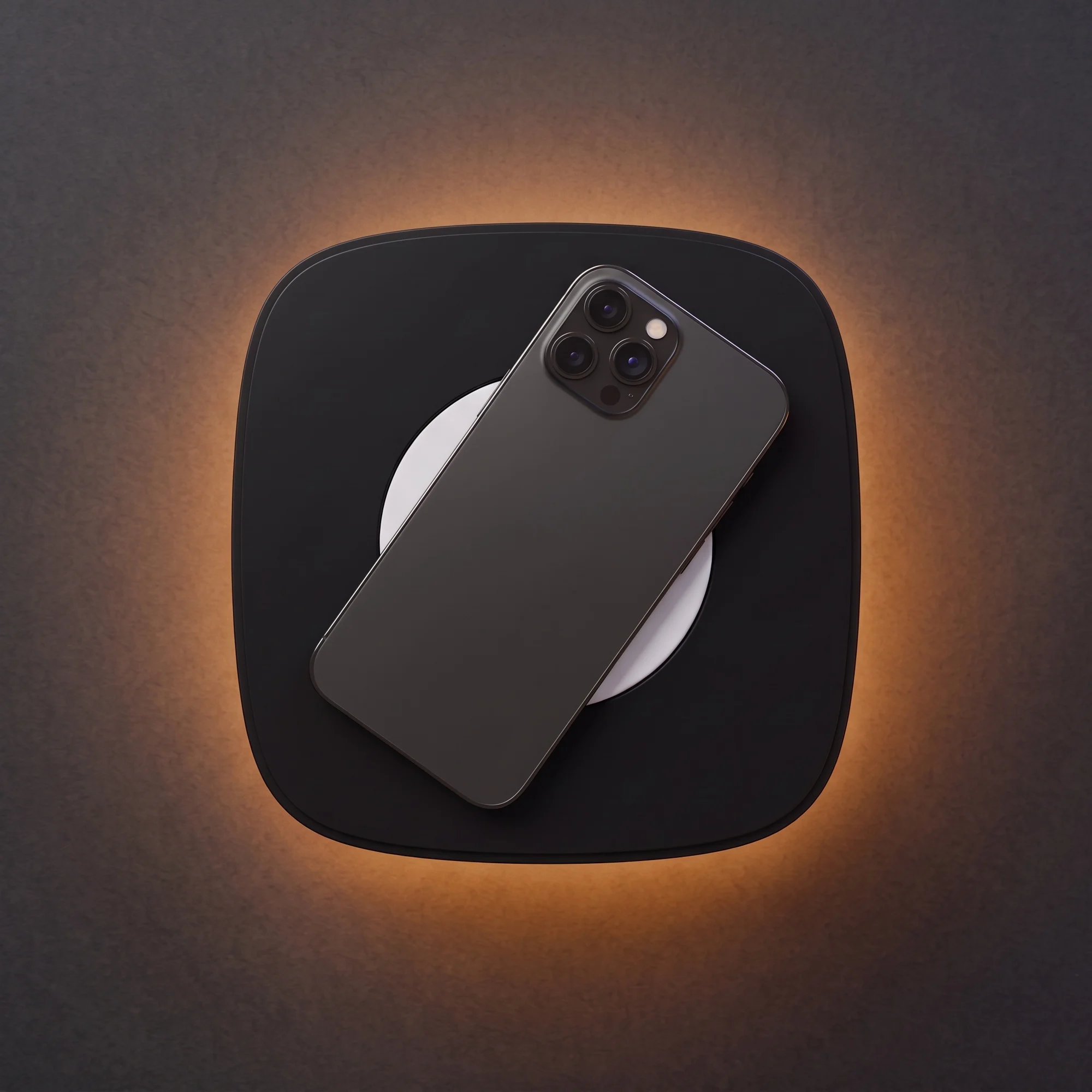
The lamp seen from above: a phone rests on the black cover of the charging module, and the white disc of the charger shows beneath it.
View from above. The white puck is set into the cover, and the phone settles onto it without you having to find the right spot.
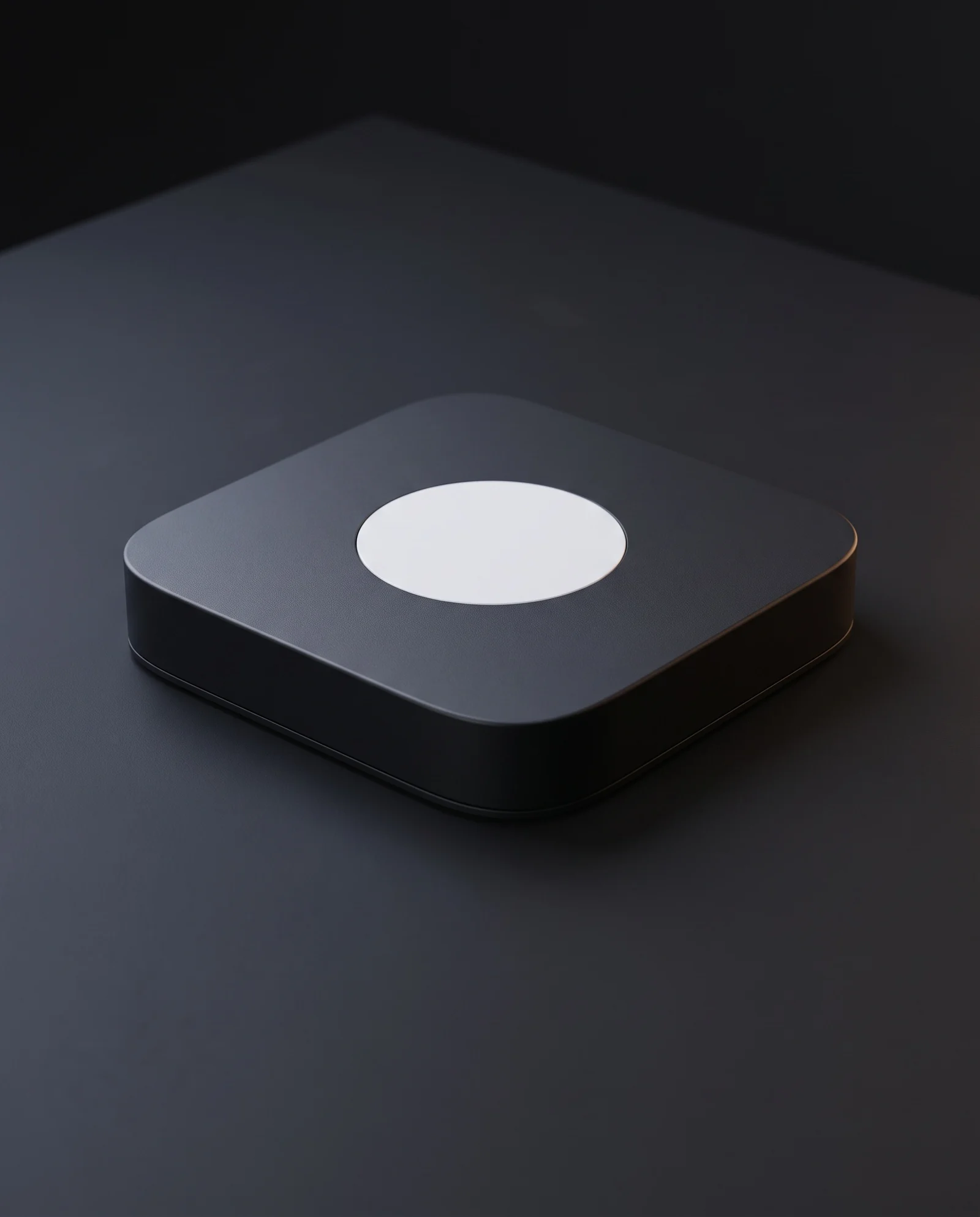
The charging module on its own, on a black table, seen from behind and above: a thin square tray, with the white charger disc flush with the top face. The back is smooth, with no cable.
Render. The module on its own, seen from behind: nothing sticks out of it.

We don’t build a charger. We hold one.

We could choose between two paths: design our own charging coil, with its certifications, magnets and firmware, or make a perfect recess for a charger that already exists and works. We chose the second path. Apple’s original puck is thin, aligns itself with the phone and is kept up to date by the people who made the phone. We print a part around it, accurate to a tenth of a millimeter.

That means the module is sold in two ways: with your charger, if you already have one, or, later, in a bundle with the puck included. The part is the same. The 15 W and 25 W versions of the puck have the same diameter, so both fit.

We say clearly what’s compatible with what. MagSafe is Apple’s trademark, not ours, and it doesn’t appear in the product’s name. It appears only where we tell you which charger to put in it.
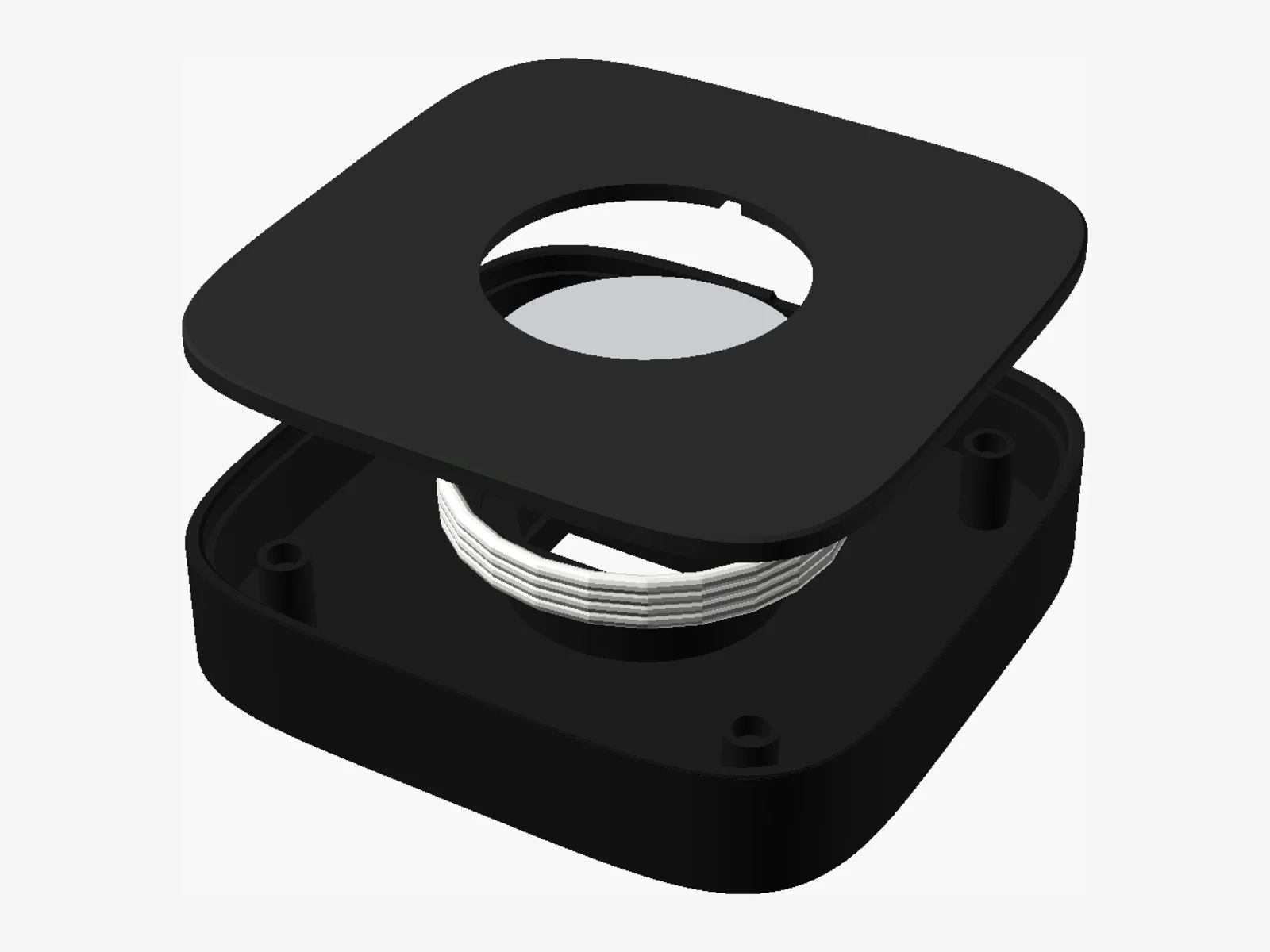
Exploded drawing from the 3D model: the black cover with the round hole, below it the white puck with the cable wound around it, then the module body with the four bosses for the magnets.
Drawing from the model. The cover, the puck with the wound cable and the body.

The cover, the recess and the cable.

The top face is a removable cover, held by four magnets in the corners, with a discreet notch at the back for your fingernail. In its middle is a 54 mm hole with a one millimeter lip. Under the lip, the recess is 56 mm, the size of the puck, plus a little clearance. The puck goes in from below, the lip holds it, and its white face sits one millimeter below the face of the cover. No metal edge shows and nothing slides.

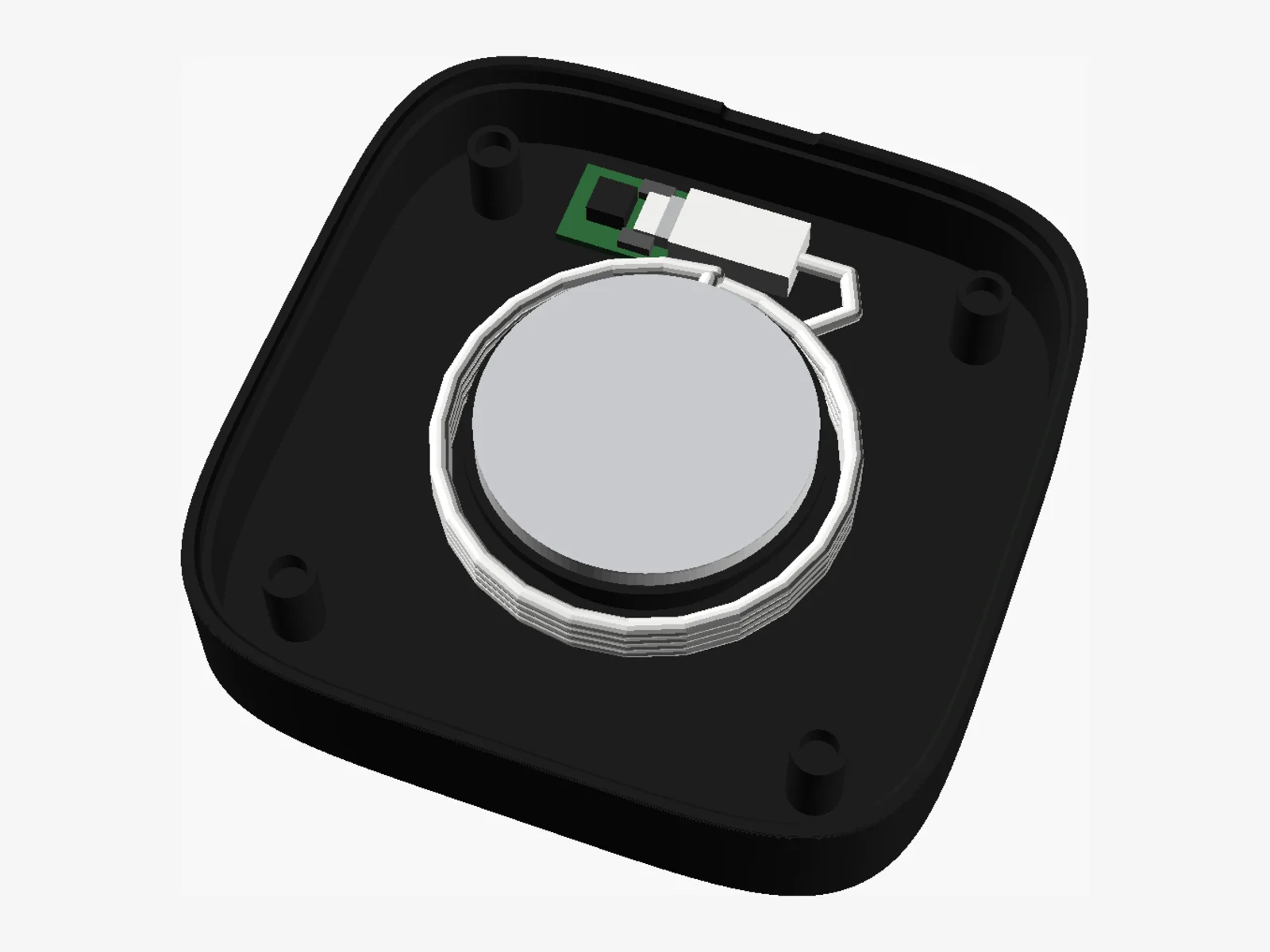
The cable doesn’t leave the lamp. It’s wound a few times around the puck, inside the module, and plugged into a USB-C socket on a small power board placed at the back. The board draws power from the lamp’s bus, through the same contacts the light uses. On the back of the modules there’s no channel, no wire, nothing to hide behind the lamp.

The module’s body is like the frame of a slice: the connector in its window, four magnets and four centering pins underneath. It’s printed bottom face down on the bed, without supports, like every part of the lamp.

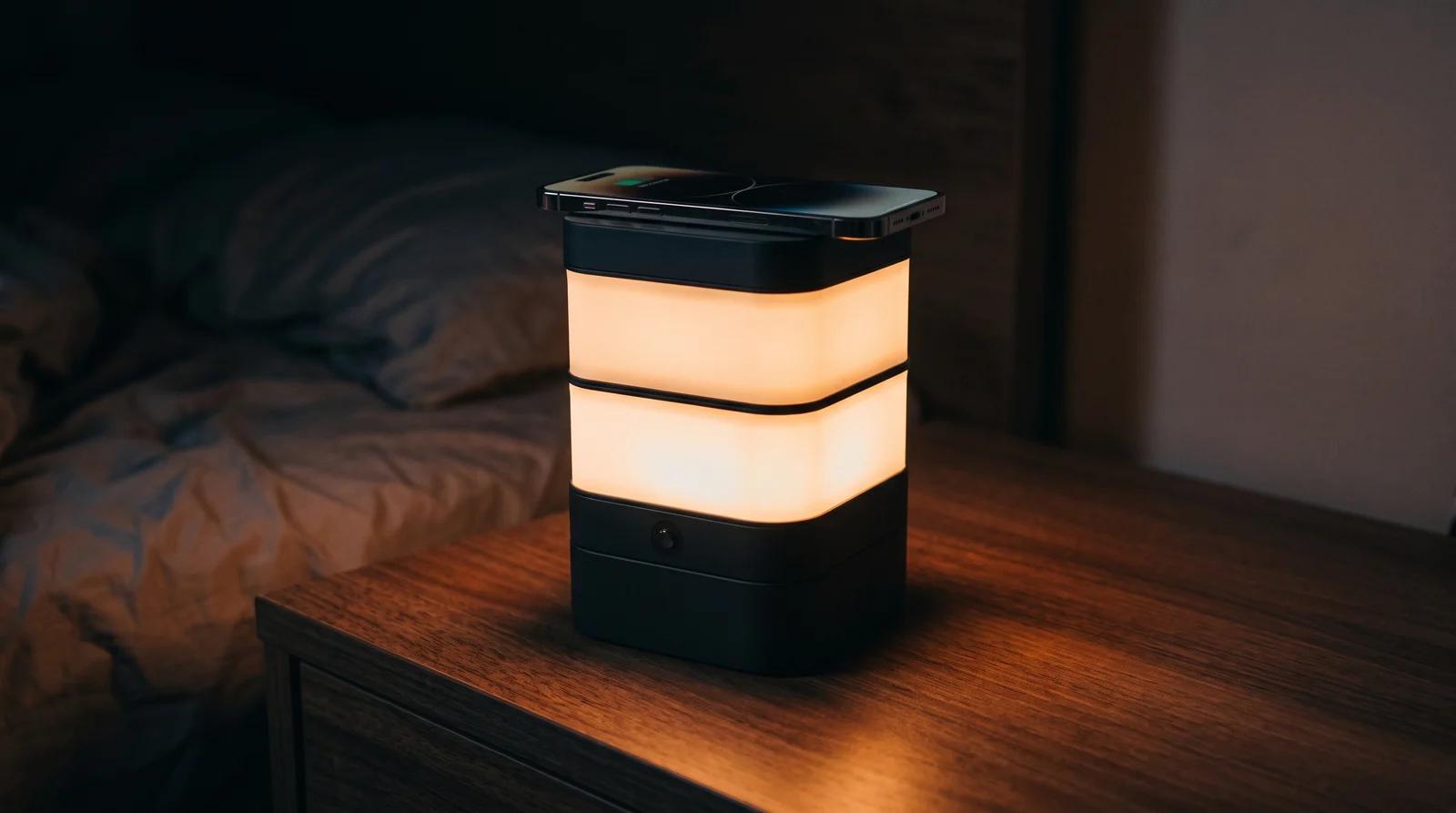
The lamp on a wooden nightstand, at night, with two warm light slices lit and a phone lying on the charging module on top.
Render. The phone lying on the lamp, in the bedroom.

The phone lies flat. The watch, later.

We didn’t tilt the surface and we didn’t add a stand. The phone lies flat on the lamp, with its magnets on the puck’s magnets, and charges. At night it doesn’t light up your face, and in the morning you pick it up in one motion. If you want to see the screen, the lamp is next to the bed, not in place of the alarm clock.

The module sits on the bus like any other, above the light. The base will recognize it once the select chain arrives, in the second version of the bus; until then it’s simply the top layer.

For the watch we’re preparing a separate module, with the original watch puck set into the front wall, so the watch sits against the side of the lamp, with the strap hanging down. It’s designed, not printed, so we’ll talk about it later.

Without a charger: the C16 cover.

Not every lamp needs a charger. A stack without one is closed with C16, a solid 16 mm cover, with the same smooth face, the same magnets and the same fine joint as the rest of the modules. From above it looks like a module that does nothing, and that’s exactly what it is: a clean finish.

If later you want charging, you take off the cover and put the module in its place. You don’t take anything else apart.

Drawing from the 3D model, with the cover removed: the white puck in its ring, the cable wound a few times around it and the green power board with the USB-C socket, at the back left.
Drawing from the model, without the cover. The cable makes a few turns around the puck and goes into the board at the back.

Where we are with it.

The module exists as a parametric model, with all its dimensions, and as renders made from it. We haven’t printed it yet. The dimensions that depend on the parts we buy, the diameter and thickness of the puck, the thickness of the cable, the plug, the power board, are marked in the model and will be measured on the real objects before the first print.

In the v0 prototype the puck stays on its own adapter, because the bus still runs at 5 V. Power from the lamp comes with the move to 20 V over USB-C PD, when the board in the module can deliver the 15 V the 25 W puck needs. We won’t promise charging speeds until we’ve measured them.

Specifications.

Internal code M24 · C16. The dimensions are those of the v0 prototype and may change.

Height
24 mm, six steps on the 4 mm grid. M20 is the module’s old name; 20 mm wasn’t enough for the puck, the board and the cable.
What it holds
The original Apple MagSafe puck, the 15 W or the 25 W version. It has no coil of its own.
Puck
Ø 56 mm, with 0.3 mm of clearance on the radius in the recess. The cover hole is Ø 54 mm, the lip 1 mm.
Top cover
Removable, held by 4 magnets of 6 × 3 mm, with a notch at the back for a fingernail. Its chamfer makes the fine joint with the body.
The cable
Stays in the module, wound around the puck, with the USB-C plug in a power board at the back. No channel on the outside.
Power
From the lamp’s bus. In v0 the puck stays on its own adapter; power from the lamp comes with the 20 V bus.
Bus
The same connector and the same 4 magnets as any module; it couples in only one orientation.
The C16 cover
16 mm, closes the stack when you don’t want a charger. The same magnets, the same joint.
Status
Parametric model and renders. Not printed yet; the dimensions marked for measuring will be checked on the real parts.
Trademarks
MagSafe is a trademark of Apple. We use it only to describe compatibility, not in the product name.