HEYLOLA. A small workshop in Romania.
We make products with a story, with an impact on people’s lives and with care for the environment. We design them, 3D print them and assemble them by hand, in small batches, and we don’t make anything nobody has ordered. STRAT, the lamp on the nightstand, is the first of them.
- The name.
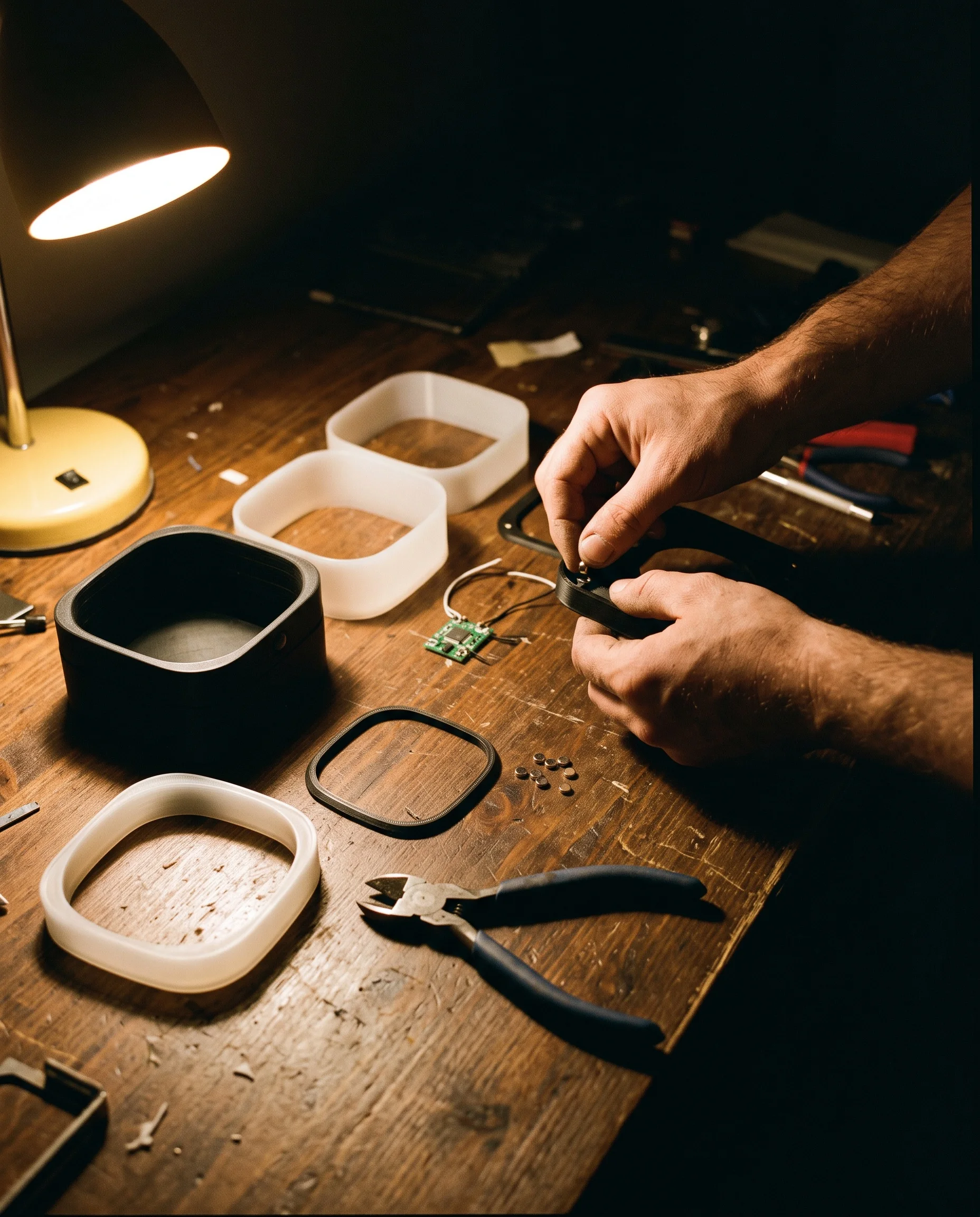
- It comes from Lola, the workshop’s Labrador, and from the way we call her ten times a day: hey, Lola.
- The workshop.
- We 3D print in Romania, on a Bambu Lab X2D, in PLA made from plant starch, and we assemble every part by hand.
- The first product.
- STRAT, a bedside lamp made of magnetic layers, with no account and no cloud. The prototype is a work in progress.
What we believe.
Products with a story.
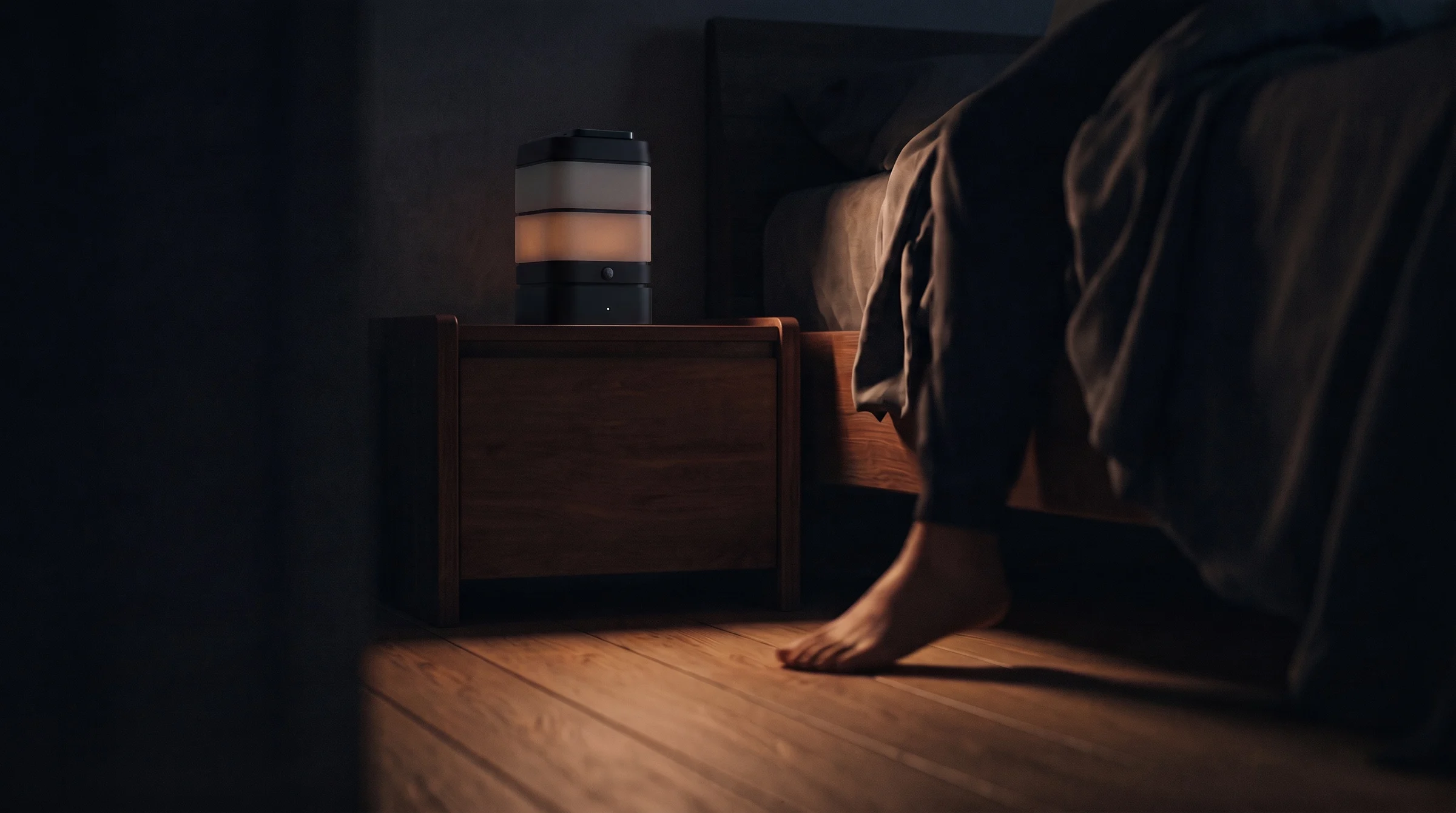
STRAT didn’t start from a business plan but from an ordinary night: someone gets out of bed in the dark, gropes for the switch, turns on a light that’s too bright and wakes everyone up. The next day, on paper, there was a lamp that sees the floor and gives only as much light as it needs to.
That’s how we want everything we make to begin: with a moment in someone’s life, not with a category in a catalog. If we can’t say in two sentences why a product exists, we don’t make it.
Impact for people.
A good object changes your day a little, for the better, and then disappears. It doesn’t ask you for an app, it doesn’t send you notifications, it doesn’t make you think about it. The light comes on when you get up, the phone charges where you left it, and in the morning you know whether it’s time to open the window.
That’s how we measure what we make: not in features, but in moments when it helped you without you noticing. If after a month you’ve forgotten that the lamp is smart, we did it right.
Care for the environment.
The greenest product is the one you don’t have to replace. We don’t print anything nobody has ordered: each lamp is started only once someone is waiting for it, in small batches, on a single printer, in Romania. The housings are made of PLA, a plastic made from plant starch, and the diffuser of PETG.
And each layer is a separate part. If something breaks, we replace the part, not the lamp. If in two years you want more light, you add another slice. We’d rather make a product that lasts ten years than one that sells well for a season.
The things in your home should be yours.
We wrote the manifesto before we had a product to sell, so that we couldn’t back down. It’s about what we dislike in today’s “smart” objects and about what we promised ourselves we’d do differently.
A bulb that won’t turn on without the internet isn’t smart. It’s helpless.
“Smart” things have become dependent.
Almost everything sold as “smart” today leaves home in order to come back: you tap your phone, the command goes up to the company’s cloud, comes back down into your room, and only then does something happen. If the internet goes down, if the company changes the app, if the server is shut down because the product didn’t sell well enough, the object in your home becomes just an object. Or a subscription.
We’ve seen thermostats, locks, speakers and lamps that died not because they broke, but because someone, somewhere, decided they were no longer worth keeping alive. We don’t want to sell anything that depends on our goodwill five years from now.
Every connected object is a door into your home.
Security isn’t a feature. It’s a duty.
A motion sensor in a bedroom knows when you’re asleep and when you’re not home. A camera knows what your child looks like. This data usually travels to servers you never see, through apps with default passwords, firmware that hasn’t been updated in years and terms nobody has read. It isn’t malice, it’s haste. But the consequences are yours, not theirs.
We come from security and we know the basic rule: the safest information is the information that goes nowhere. STRAT has no account, no cloud and sends nothing outside your network. The sensor sees the bedroom floor, and what it sees stays in the lamp.
If you can’t open an object, it isn’t yours. It just lives at your place.
Closed means someone else’s.
Hardware glued, not screwed. Batteries that don’t come out. Encrypted firmware, with no documentation, with features that vanish after an update. Apps that ask for permissions for things they don’t need. Everything is designed to keep you out, so that you buy another one when the first one breaks.
We believe in the opposite: housings that come apart, parts that can be replaced, software you can read. STRAT runs on ESPHome, an open firmware you can see, modify and flash yourself. Each layer is a separate part, held on by magnets, that you take off by hand.
A new gadget every season isn’t progress. It’s consumption.
Objects made to be thrown away.
This industry lives on replacement. The color of the year, the model of the year, the feature of the year. Products designed for the photo in the store, not for their fifth year on the nightstand. Cheap materials, packaging three times bigger than the object, stock made before anyone wants it, then discounts, then waste.
We’d rather make an object that lasts ten years than one that sells well for a season. That’s why we don’t print anything nobody has ordered, we work in small batches and we have no stock. If in two years you want more light, you don’t buy another lamp: you add another slice.
What we commit to.
- Local, by default.
- Everything the lamp does happens on your network. No account, no cloud, no subscription.
- Open, not just “compatible”.
- ESPHome firmware, MQTT, the native Home Assistant API. You can read the code and you can change it.
- Repairable by hand.
- Magnetic layers, separate parts, nothing glued for good. We replace the part, not the product.
- No stock.
- We print to order, in small batches. Nothing is made before someone wants it.
- No features that disappear.
- What you buy today keeps working even if we disappear tomorrow. The lamp doesn’t need us to work.
- Said plainly.
- The images are renders, the prototype is a work in progress, the price doesn’t exist yet. We don’t promise what we don’t have.
If you believe the same.
STRAT is the first object made by the rules above. The first batch will be small, printed and assembled in Romania, one at a time.